
One habit, 30 days
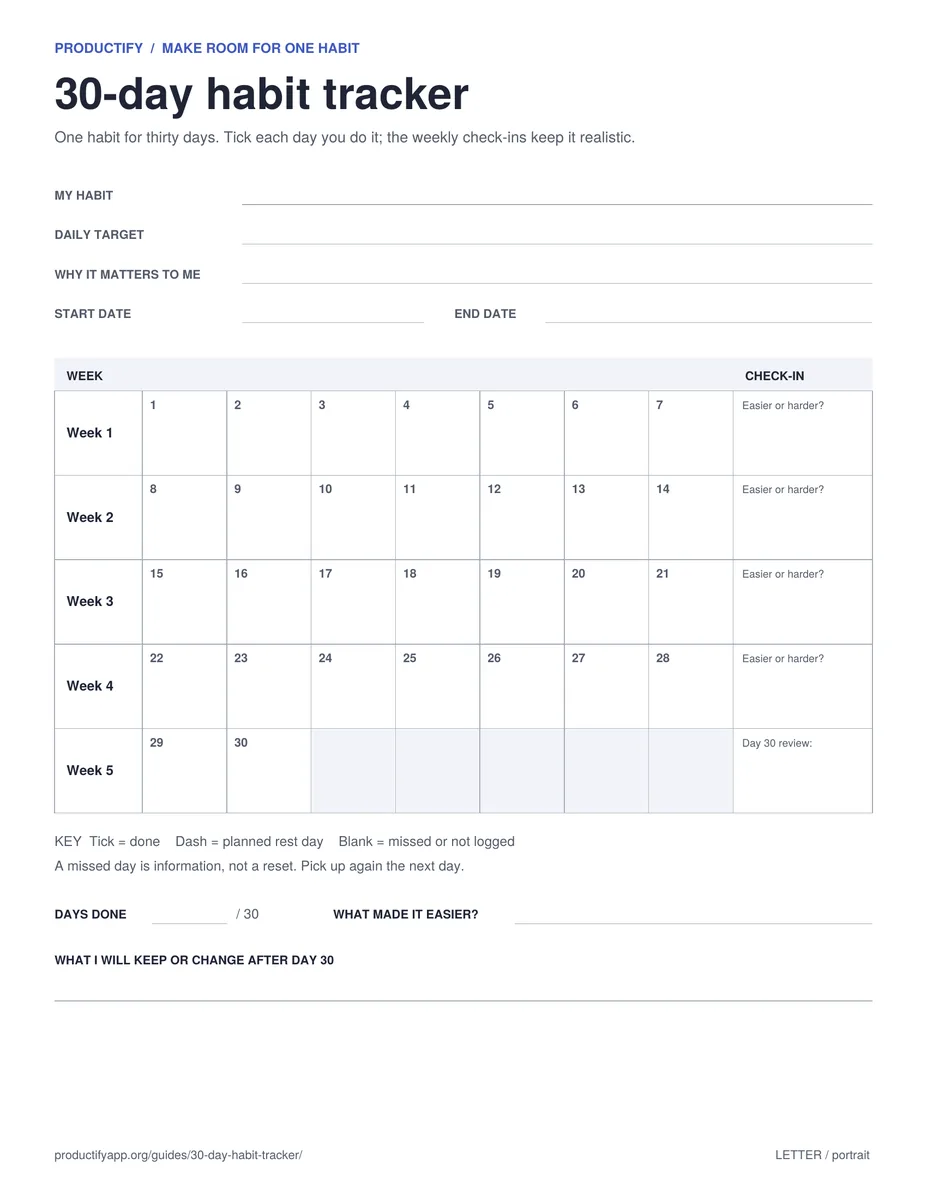
Thirty large squares arranged in weeks, with room to write your habit, daily target, and reason. Each row ends with a short check-in so you can make the habit easier before it slips.
Portrait · Best for a first challengePick one habit, give it thirty days, and tick a square each day you do it. Weekly check-ins help you adjust along the way, and the day-30 review helps you decide what comes next.
A4 & US Letter · Start on any date · No email or account required
Each option opens a one-page PDF in a new tab. Use your PDF viewer’s Download or Print button, match the paper size, and print at actual size or 100%.
Thirty large squares arranged in weeks, with room to write your habit, daily target, and reason. Each row ends with a short check-in so you can make the habit easier before it slips.
Portrait · Best for a first challenge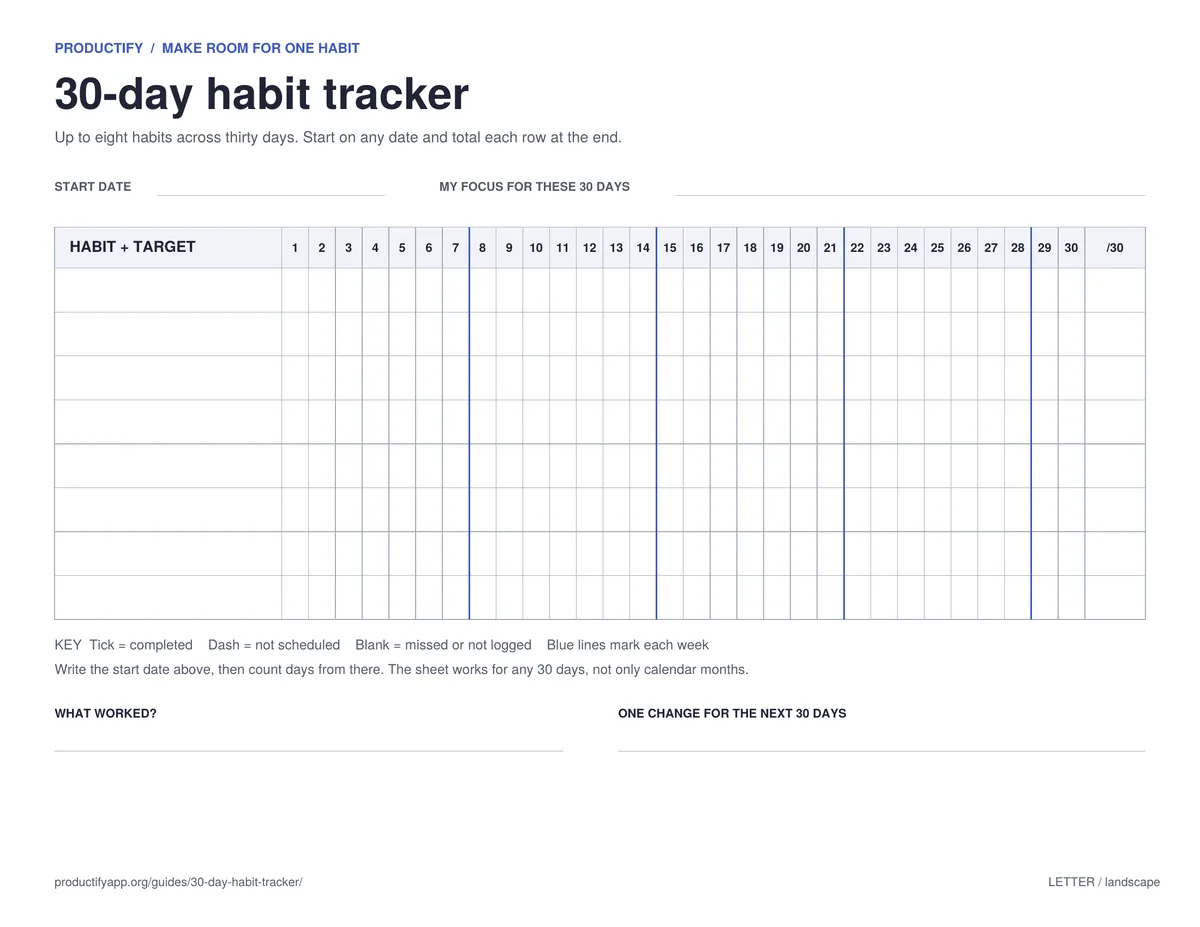
A landscape grid with columns for days 1 to 30, lines marking each week, and a total column for each habit. Useful when you want to see a whole routine on one page.
Landscape · Total each row out of 30Thirty days is long enough to learn what a habit costs you and short enough to commit to. It is not a guarantee that the habit will feel automatic by the end. In the best-known habit research, the median time for a behavior to feel automatic was about 66 days, and the estimates varied a lot between people and behaviors.
So treat day 30 as a checkpoint. If the habit is still helpful, carry it into a monthly habit tracker, or use the habit streak calculator to see when you will pass 66 or 100 days.
Choose something you can do in under 15 minutes on most days. You can grow it later.
| Area | A 30-day habit to try |
|---|---|
| Movement | Walk 15 minutes after lunch, or stretch for 5 minutes before bed |
| Reading | Read 10 pages or 10 minutes a day (see the reading habit guide) |
| Sleep | Phone out of the bedroom, or lights out by the same time each night |
| Mind | Write one line in a journal, or sit quietly for 5 minutes |
| Home | A 10-minute tidy before dinner |
| Learning | Practice a language or instrument for 10 minutes |
| Food | A glass of water before coffee, or a home-cooked dinner on weekdays |
| Screen time | No phone for the first 30 minutes after waking |
Need more options? Browse 30 habit tracker ideas for daily and weekly routines.
Leave the square blank and pick up the next day. You do not need to restart at Day 1. At the end, “24 out of 30 days” tells you far more than a streak that ended on day 9. If misses keep landing on the same weekday, plan that day as a rest day and mark it with a dash before it arrives.
If a habit keeps slipping, the habits that stick guide walks through what to change.
Paper is visible and satisfying to tick, which is why many people start a challenge on a printed sheet. Productify is an iPhone habit tracker that adds reminders, streaks, and a calendar of completed days, which helps once the 30 days are over. The printable works without the app, so use whichever you will actually check.
No. The sheets are numbered Day 1 to Day 30, not by calendar date, so you can start on any day. Write the start date at the top and count from there.
Thirty days is a useful trial, not a finish line. In the most cited study, the median time for a behavior to feel automatic was about 66 days, and individual estimates varied widely. Use day 30 to decide whether to keep, adjust, or stop the habit. Read how long it takes to build a habit for the research.
Leave the square blank and continue the next day. A missed day does not cancel the challenge. Count your days done at the end rather than restarting from Day 1. If misses cluster on the same days, make the habit smaller or plan a rest day with a dash.
If this is your first challenge, start with one habit on the single-habit sheet. Use the multi-habit sheet when you already have a routine and want to see several habits side by side for the same 30 days.
Choose US Letter for 8.5 × 11 inch paper and A4 for 210 × 297 mm paper. Print at actual size or 100%. The single-habit sheet is portrait; the multi-habit sheet is landscape.
Yes. Download and print them for personal use. No email address, account, payment, or app is required.
More free resources: the year in pixels printable, the habit streak calculator, and all free habit tools.
