
30 Habit Tracker Ideas for Your Daily and Weekly Routine
Looking for habit tracker ideas? Start with a repeatable action you want to make room for: reading, movement, a focused work session, or a weekly review. These 30 ideas include daily and weekly options, plus examples of what to record and when.

Five habit tracker examples you can adapt
A useful entry names an action, a schedule, and a finish line. These are example targets, not requirements. Make them smaller or change the timing to fit your day.
| Idea | Example schedule | What to log |
|---|---|---|
| Read more | After dinner, daily | 10 minutes read |
| Move regularly | After lunch on weekdays | A walk of a length that works for you |
| Practice a skill | Monday, Wednesday, Friday | 15 minutes of practice |
| Prepare for tomorrow | Before finishing work | Write tomorrow's first task |
| Review the week | Sunday afternoon | Write one thing to keep and one to change |
For something you only need to finish once, use a to-do list. For an action you want to repeat, use a habit tracker. See how the two differ.
How to choose the right habits to track
Before picking from the list below, apply three filters to any habit you're considering:
- Is it specific? "Exercise" is not trackable. "Walk for 30 minutes" is. You need to be able to answer "did I do this?" with a clear yes or no.
- Is it daily (or on a fixed schedule)? Habit trackers work best for behaviours you intend to do every day, or on set days of the week. Use a schedule that reflects when you realistically intend to do the action.
- Do you actually want this? Choose an action with a reason that matters to you. A smaller habit you want to practice is a useful place to start.
Start with one habit if the list feels overwhelming. You can keep the other ideas for later. Add another when the first fits your routine and checking in is manageable.
Health & fitness habits
These are common areas people choose to track. Select actions and targets that fit your circumstances and any relevant professional advice.
- Daily movement (20-30 min) Walk, run, cycle, swim, any intentional movement. Choose a form of movement that fits your abilities and preferences.
- Keep water available Refill your water bottle at a regular point in your day. Choose an amount appropriate to your needs.
- Consistent sleep time Track whether you went to bed at your target time. Use the record to notice how your schedule changes across the week.
- 10 minutes of stretching Choose movements that are comfortable for you and a time when you can practice them.
- No alcohol on weekdays A clear, binary target. Choose a target that fits your circumstances.
- Eat vegetables with every meal Simpler than tracking calories; creates a positive default rather than a restriction.
Mind & focus habits
These habits protect and develop your capacity for deep work, creative thinking, and continuous learning, the compounding assets of a knowledge worker's life.
- Read 10-20 pages Non-fiction or fiction, consistent reading compounds into extraordinary breadth of knowledge over years. Our seven-day reading habit plan starts with five minutes and includes a one-page fallback.
- 90-minute deep work session One uninterrupted focus block per day. Phone away, notifications off. Track whether it happened. For scheduling examples, see productivity habits at work.
- No social media before 10am Protects your morning from reactive, distracted thinking. One of the highest-leverage digital hygiene habits.
- Learn something new (15 min) Language app, online course, podcast on a new subject, any intentional learning beyond your current domain.
- Review tomorrow's priorities tonight Write down the first task you want to work on tomorrow, then check it when your day begins.
- No phone 1 hour before sleep Try putting your phone away during your wind-down routine and record whether the plan fits.
Morning routine habits
Choose a morning habit that fits between things you already do, such as waking, breakfast, and leaving home. For a full guide, see our morning routine page.
- Wake up at target time Choose a realistic wake time and record how often your schedule allows it.
- Drink water immediately on waking You've been fasting for 7-8 hours. Hydration first thing is an easy, immediate win.
- 5 minutes of journaling Free writing, gratitude log, or intention-setting. Clarifies thinking and sets a calm, intentional tone.
- Morning sunlight (10 min outside) Spend a little time outside if it suits your schedule and circumstances.
- Prepare breakfast Choose a simple breakfast and prepare what you need ahead of time.
- Prepare your bag for the day Check for the items you will need before you leave home.
Mental wellbeing habits
These are ideas for making space to pause and reflect. Choose an activity you find useful and adapt its length to your day.
- 5-10 minutes of meditation Any method: guided, breath-focused, or body scan. Start with a length of time that feels manageable.
- Gratitude (3 things) Write down three specific things you're grateful for. Use a notebook or a note on your phone.
- Spend time in nature (20 min) Choose an outdoor setting you enjoy, such as a park or garden.
- No news consumption before noon Choose a later time to check the news and record whether you kept that boundary.
- Breathwork (5 min) Set aside a few quiet minutes to pause and notice your breathing if you find that comfortable.
- End-of-day shutdown ritual Close your work tabs and write down tomorrow's first task. Record whether you finished this short routine.
Relationships & growth habits
Connection, creativity, and learning may also deserve a place in your routine. Choose what matters to you instead of limiting the list to work and physical activity.
- Reach out to one person Text, call, or message one friend, family member, or colleague. Maintains social connections without requiring scheduled time.
- Write 200 words (any topic) Daily writing practice builds communication skills and creative thinking across all domains, not just writing itself.
- Practice a skill for 20 minutes Instrument, language, sport, coding, drawing, deliberate practice on a skill you want to develop.
- No complaints for the day A challenging but powerful habit. Track it as a binary yes/no. Shifts your attentional default from problems to solutions.
- One act of generosity Any form: compliment, help offered, favour done. Choose an action the other person is likely to welcome.
- Weekly review (on Sundays) Review the week: what worked, what didn't, what to adjust. Track as a weekly habit. The most underrated productivity habit.
A completed tracker with daily and weekly habits
Here is how three ideas can fit into one week. These are example entries; choose the number of habits and targets that suit you.
| Habit and schedule | Mon | Tue | Wed | Thu | Fri | Sat | Sun |
|---|---|---|---|---|---|---|---|
| Read 10 minutes Weekdays | ✓ | ✓ | ✓ | ✓ | — | — | |
| Practice a skill Tuesday, Thursday, Saturday | — | ✓ | — | — | ✓ | — | |
| Review the week Sunday | — | — | — | — | — | — | ✓ |
Reading was completed on 4 of its 5 planned days; practice on 2 of 3. Days off do not count as misses. In this example, the blank cells are known missed sessions. If you simply forgot to log, leave a note rather than guessing what happened.
Try the same setup on paper with our free printable habit trackers. Choose a monthly grid or a weekly sheet in A4 or US Letter. Weekly sheets have Monday and Sunday starts, with no email required. Testing a single habit? The 30-day habit tracker gives it a one-month trial.
Set up one habit, then review the first week
Suppose you choose reading. In Productify, create a reading habit, set a target such as 10 minutes, choose the days you intend to read, and add a reminder after dinner. You can create a custom habit or start from the template library.
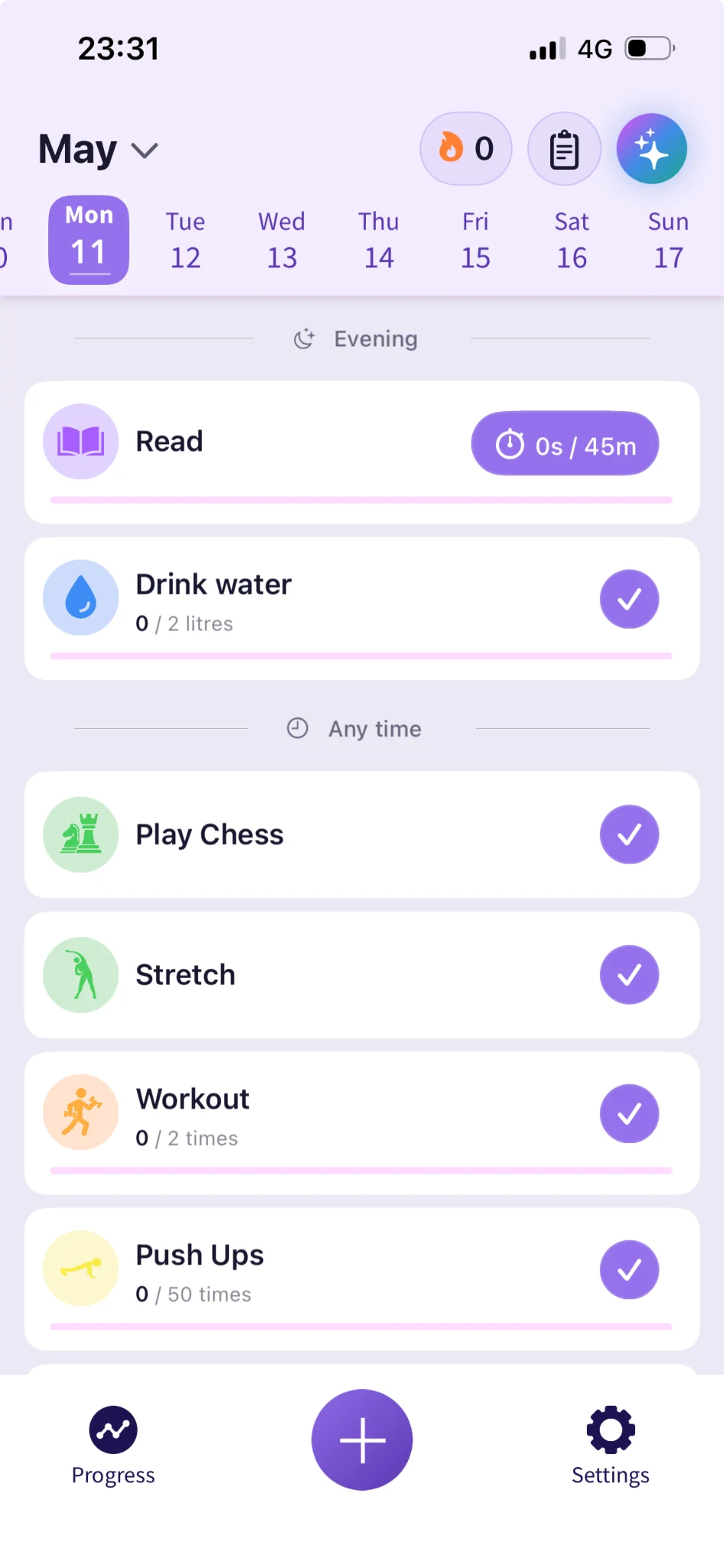
- Choose the smallest useful version. If 10 minutes is too much for a busy evening, start with a shorter reading session.
- Record what happened. Log the time you actually read. For a check-off habit, mark it complete only when the action is done.
- Review the scheduled days. Notice which days you missed and whether the timing or target got in the way.
- Change one thing. Try an earlier reminder, a smaller goal, or a different schedule for the next week.
A week of check-ins shows how the setup fits your life; it does not prove a habit is automatic. Read what habit-formation timelines mean before treating a streak as a deadline.
Ready to track an idea? See how Productify's habit tracking app handles reminders, measurable goals, and your daily record. The free plan includes up to 5 habits and 5 starter templates. If you prefer to practice with someone, Habit Duo is available on Pro.
Frequently asked questions
Track recurring behaviours you want to perform daily or weekly, not one-time tasks. The best habits to track are specific (clear yes/no completion), personally meaningful (you actually want to do them), and repeatable (not things that only happen occasionally). Good examples: exercise, reading, journaling, hydration, sleep consistency, meditation, and screen-free time.
Try one or two habits while you learn what fits your schedule. Add another when practicing and logging the existing habits feels manageable. There is no universal ideal count; use your weekly review to decide whether the list needs to grow or shrink.
Yes. A Sunday review or practice session on three chosen days belongs in a habit tracker too. Judge completion against the planned schedule, so a day off is not treated as a missed daily habit.
Try preparing breakfast, packing your bag, writing a few journal lines, or choosing a consistent wake-up time. Pick one action that fits your morning and define what you will record. You do not need a long routine for a habit to be worth tracking.
Generally no. Tracking an already-automatic habit (like brushing teeth) adds check-in overhead without adding value, you're going to do it anyway. Reserve your habit tracker for behaviours that aren't yet automatic and need daily reinforcement. Once a habit becomes truly automatic, you can remove it from your tracker and add a new one.
Related reading
- How to build an evening routine that actually winds you down
- How to use a habit tracker: a complete beginner's guide
- How to start a daily habit (even if you've failed before)
- Habit templates, 50+ ready-made daily habits in Productify
- Build a morning routine with Productify
- Productify habit tracker: full feature overview
