End-of-Day Reflection: 8 Questions to Ask Yourself Tonight
Most days end without a last look. You put the phone down, today blurs into yesterday, and by Friday you can’t say what Tuesday was like. An end-of-day reflection fixes that in a couple of minutes: one question, one honest sentence, written down.
This article gives you eight questions that are worth asking, an example answer for each, a way to choose tonight’s question, and a short routine for making it a habit. The eight are the questions built into the diary in Productify, our habit tracker. They work just as well in a paper notebook.
What an end-of-day reflection is
An end-of-day reflection is a short look back at your day before you sleep. It has three small parts: you recall what actually happened, you answer one question about it, and you sometimes note one thing for tomorrow. Two to five minutes is enough.
It helps to be clear about what it isn’t. It isn’t a full journal entry, although one sentence in a journal is the easiest way to do it. It isn’t a performance review, where every day gets a grade. And it isn’t new: Seneca describes going over his whole day each night once the lamp had been taken away, a practice covered in the Stoic evening review.
The reason to do it daily is that days are easy to lose. A week later, you remember the outline of a week and almost none of its details: which evening the walk felt good, what made Wednesday so tiring. Those details are what tell you what to keep and what to change.
The 8 end-of-day reflection questions at a glance
- What made today easier?
- What was one small win today?
- What do you want to remember?
- What drained you, and what helped?
- Who made you smile today?
- What are you grateful for right now?
- What will you do differently tomorrow?
- How did your habits feel today?
You don’t answer all eight. One question a night is the whole practice. The sections below explain what each one is for and when it fits.
Questions for looking back at the day
1. What made today easier?
This question looks for causes. The answer is usually something small and repeatable: a thing you prepared the night before, a person who helped, a meeting that got cancelled, a decision you made early. Asked for a week, it produces a list of what works for you, written in your own words.
Example“Packed my gym bag last night, so this morning I just went.”
Good for: ordinary days, and for finding out what to do again.
2. What was one small win today?
Most days contain progress that nobody records. Teresa Amabile and Steven Kramer collected nearly 12,000 daily diary entries from 238 employees and found that people’s best workdays were the ones on which they made progress, often in small steps. Naming one small win each night is a way of noticing that progress before it disappears. The word “small” matters: you are looking for the email you finally sent, not a promotion.
Example“Sent the email I’d been avoiding since Monday.”
Good for: days that felt unproductive, and weeks when a big goal seems far away.
3. What do you want to remember?
Not every reflection has to improve something. This question turns the page into a record: a moment, a sentence someone said, the weather, a meal. It is the one you will be most glad you answered when you read the page a year later.
Example“First cold morning of the year. Had coffee on the balcony anyway.”
Good for: good days, trips, and days with nothing to fix.
Questions about energy and people
4. What drained you, and what helped?
The second half of this question is what makes it useful. Naming what drained you is honest; stopping there can turn into replaying the day. “What helped?” points at something you did, or could do, even if it only helped a little. Over a few weeks, the answers show which drains keep coming back and which remedies you actually use.
Example“Back-to-back calls until four. A ten-minute walk before dinner helped.”
Good for: hard days. Keep the answer to one or two sentences.
5. Who made you smile today?
This is the easiest question to answer when you are tired, because the answer is a name. It points your attention at people instead of tasks, and after a month the names tell you something: who you see often, and who you would like to see more.
Example“Dad, who sent a photo of his tomatoes.”
Good for: flat days, busy weeks, and evenings when you don’t feel like thinking about yourself.
6. What are you grateful for right now?
Gratitude is the most studied question on this list. In three experiments by Robert Emmons and Michael McCullough, people who regularly listed things they were grateful for reported higher well-being than comparison groups on several measures, though not all of them. The answers that work best are specific and include a reason. “My family” is true every day and stops meaning much by the second week. If your answers start to repeat, switch to another question for a while.
Example“Grateful that Sam covered my shift, so I made it to the recital.”
Good for: any day, as long as the answer is about today.
Questions about tomorrow and your habits
7. What will you do differently tomorrow?
This is the question that turns a reflection into a change. Keep the answer to one thing, and make it concrete enough to do: a time, a place, an action. An if-then sentence works well (“When I sit down to read, my phone goes in the kitchen”). In a meta-analysis of 94 studies, Peter Gollwitzer and Paschal Sheeran found that deciding in advance when and where you will act had a medium-to-large effect on reaching goals.
It may also help you switch off. In a 2018 sleep-lab study, 57 young adults spent five minutes before bed writing either a to-do list for the coming days or a list of tasks they had already finished. The to-do group fell asleep about nine minutes faster on average. It was one small study, but it suggests that writing tomorrow down is a way of putting it down.
Example“Tomorrow my phone goes in the kitchen before I sit down to read.”
Good for: days when a habit slipped or something went wrong that you can do something about.
8. How did your habits feel today?
A habit tracker shows whether you did a habit. This question asks how it went: easy, rushed, forced, enjoyable. The answer warns you early. A habit that has felt like a chore for a week is usually too big or at the wrong time of day, and you can fix that before you start skipping it. If you track habits, look at today’s record first, then answer.
Example“Stretching felt rushed at 11 pm. Moving it to right after work.”
Good for: once a week at least, and any time a streak is intact but the habit feels heavy.
How to choose tonight’s question
For the first week, use one question every night. It keeps the habit simple, and seven answers to the same question are easy to compare. After that, let the day decide:
- An ordinary day: What made today easier? Or one small win.
- A good day: What do you want to remember?
- A hard day: What drained you, and what helped?
- A flat or lonely day: Who made you smile today?
- A day when something went wrong: What will you do differently tomorrow?
- A day when your habits felt like work: How did your habits feel today?
If choosing becomes a chore, stop choosing. Three questions in a fixed order also work well: what went well, where did I fall short, and what will I do differently tomorrow? That is the Stoic set, and it fits in three sentences.
A 3-minute end-of-day reflection routine
- Tie it to something you already do. After you brush your teeth, when you put your phone on the charger, or right after your last habit of the day. A fixed moment is what makes it happen on tired evenings.
- Look at the day before you judge it. Glance at your calendar or your habit record for twenty seconds. A tired evening can color the whole day; the record is more reliable than the mood.
- Answer one question in one sentence. Write it down, on paper or on your phone. Longer is fine when you feel like it, but one sentence counts as done.
- Add tomorrow’s first step if your mind is busy. “First thing tomorrow: call the dentist.” Then you don’t have to carry it to bed.
- Stop. Close the notebook. The reflection is finished, even if the day doesn’t feel resolved.
Once a week, read the last seven answers in one go. Patterns that are invisible in a single evening show up across a week: the same drain every Tuesday, the same thing that makes days easier. For more on keeping the habit going, including what to do after a missed week, see how to make journaling a habit. If you want the reflection to be the last step of a longer wind-down, start with an evening routine you can keep.
An end-of-workday version
The same idea works before you close your laptop, and it helps separate work from the evening. Two questions are enough:
- What moved forward today? One line, even if it is small.
- What is the first thing I’ll do tomorrow? Specific enough that you can start without thinking.
There is some evidence that this is time well spent. In a field study by Giada Di Stefano, Francesca Gino, Gary Pisano and Bradley Staats, new call-center employees at Wipro in India spent the last 15 minutes of each day, on days 6 to 16 of their training, writing about what they had learned. They scored 22.8% higher on the final training test than trainees who spent those 15 minutes working. For habits that support focused work, see productivity habits at work.
What the research says, and what it doesn’t
No study has tested these eight questions as a set. What exists is evidence for the kinds of thinking they ask for:
- Reflecting on what you did helps you learn from it. In the Wipro study above, trainees who wrote about each day’s lessons outperformed those who used the same time for more practice.
- Noticing what went well can lift mood for longer than you would expect. In a placebo-controlled online study by Martin Seligman and colleagues, people who wrote down three things that went well each night for one week, and why they went well, reported more happiness and fewer depressive symptoms over the following six months.
- Gratitude lists help somewhat. Emmons and McCullough’s gratitude groups did better than comparison groups on several measures of well-being, most consistently on positive mood.
- Small progress matters to how a day feels. That is the finding from Amabile and Kramer’s diary study.
The limits are worth knowing. These studies tested specific exercises over days or weeks, mostly with volunteers, and they report averages. Some people got nothing from them. A nightly question is cheap enough to test on yourself: try it for two weeks, read the answers back, and keep it if they tell you something.
When reflection turns into rumination
Looking back at a day is not always pleasant, and there is a version of it that makes things worse. Psychologists Paul Trapnell and Jennifer Campbell drew a line between two kinds of attention to yourself: reflection, which is driven by curiosity, and rumination, which keeps returning to threats, losses and things that felt unfair. The first tends to go with knowing yourself better. The second goes with feeling worse.
A few habits keep an evening reflection on the right side of that line:
- Write, don’t replay. A sentence on a page has an end. A thought in bed doesn’t.
- Keep it short on bad days. One sentence about what happened, one about what helped.
- End with a next step, or just end. “Tomorrow I’ll ask for the deadline to move” is a good last line. So is closing the notebook.
- Change the question. If the hard questions keep you circling, answer “Who made you smile today?” for a week instead.
An evening reflection is a habit, not a treatment. If low mood or worry lasts for weeks, or going over your day regularly leaves you feeling worse, talk to a doctor or someone you trust.
The same questions in Productify
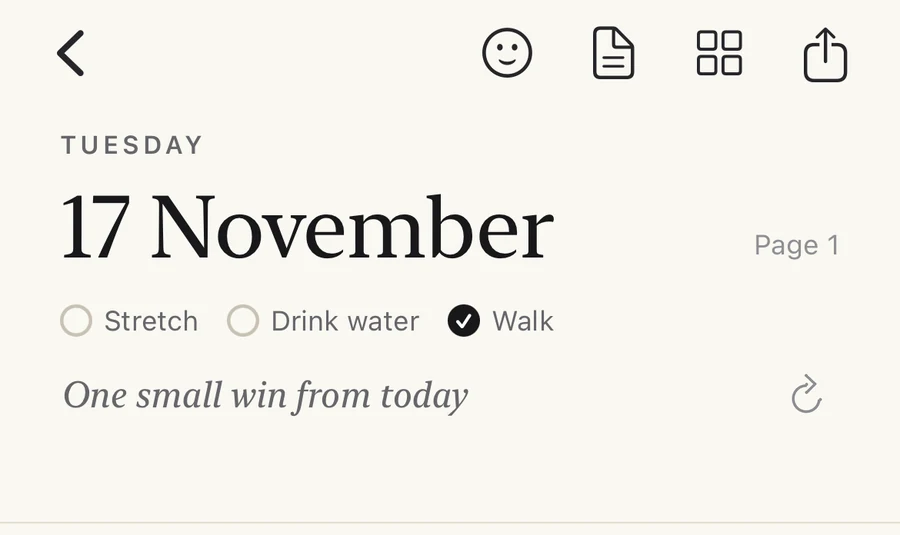
Productify is our app, so read this section with that in mind. Its diary gives you one page for every day, inside the habit tracker. Each page already shows the date, that day’s habits with their checkmarks, and one of the eight questions above. If the question doesn’t fit your day, tap ↻ for another one.
- The cue is built in. After 6 pm, once every habit due today is done or skipped, a “How was today?” card on the home screen opens the diary. You can also tap + and choose Diary.
- The day’s record is on the page. You see which habits you did before you answer, which is step two of the routine above.
- Type or write by hand. Type on the lines, or use the pencil, pen or highlighter to write on the page.
- Easy to read back. Swipe across the date to go back a day, or open the grid of all your pages for the weekly read-through.
- Private. Pages save by themselves and stay on your phone.
The diary is part of the free plan, which covers up to 5 habits with no account required. If you prefer paper, a notebook by the bed and the list of questions above do the same job.
Sources and limits
- Di Stefano, Gino, Pisano & Staats, Learning by Thinking: How Reflection Aids Performance (Harvard Business School working paper, summarized by HBS Working Knowledge). Field study with call-center trainees at Wipro.
- Seligman, Steen, Park & Peterson (2005), Positive psychology progress: empirical validation of interventions. American Psychologist, 60(5), 410–421. Six-group, placebo-controlled internet study.
- Emmons & McCullough (2003), Counting blessings versus burdens: an experimental investigation of gratitude and subjective well-being in daily life. Journal of Personality and Social Psychology, 84(2), 377–389.
- Amabile & Kramer, The Progress Principle (Harvard Business School Working Knowledge): nearly 12,000 daily diary entries from 238 employees in seven companies.
- Gollwitzer & Sheeran (2006), Implementation intentions and goal achievement: a meta-analysis of effects and processes. Advances in Experimental Social Psychology, 38, 69–119.
- Scullin et al. (2018), The effects of bedtime writing on difficulty falling asleep: a polysomnographic study comparing to-do lists and completed activity lists. Journal of Experimental Psychology: General, 147(1), 139–146. 57 participants, one night in a sleep lab.
- Trapnell & Campbell (1999), Private self-consciousness and the five-factor model of personality: distinguishing rumination from reflection. Journal of Personality and Social Psychology, 76(2), 284–304.
We make Productify, a habit tracker app with a diary. The summaries above describe what each study measured; the eight questions and the routine are our suggestions, not tested programs.
Frequently asked questions
It is a short look back at your day before you go to sleep, usually two to five minutes, guided by one or two questions. You notice what happened, what helped, and what you want to change, and you write down a sentence so you can read it later. It is shorter than a journal entry and it is not a performance review.
Eight that work well: What made today easier? What was one small win? What do you want to remember? What drained you, and what helped? Who made you smile today? What will you do differently tomorrow? What are you grateful for right now? How did your habits feel today? Answer one a night, not all eight.
Two to five minutes. One question answered in one sentence is a complete reflection. If it regularly takes longer than five minutes, it becomes easy to skip on tired evenings, which are the evenings it helps most.
Use the same question for the first week, so the habit is easy and your answers can be compared. After that, choose the question that fits the day. If your answers start repeating word for word, switch to a different question for a while.
Thinking it through is better than nothing, but writing is worth the extra minute. A written sentence forces you to finish the thought, and it gives you something to read back at the end of the week, when patterns across several days become visible.
Keep it to one plain sentence about what drained you and one thing that helped, even slightly. You don’t need to analyze the day or find a lesson in it. If you would rather not go over it at all, answer an easier question, such as who made you smile today.