
25 Habit Stacking Examples for Morning, Work, and Evening
You already put a cup down, finish a meeting, and get ready for bed. Each is a possible moment to begin something small. These 25 habit stacking examples pair an everyday cue with one action, a realistic time estimate, and an alternative for days when the cue disappears.
What is habit stacking?
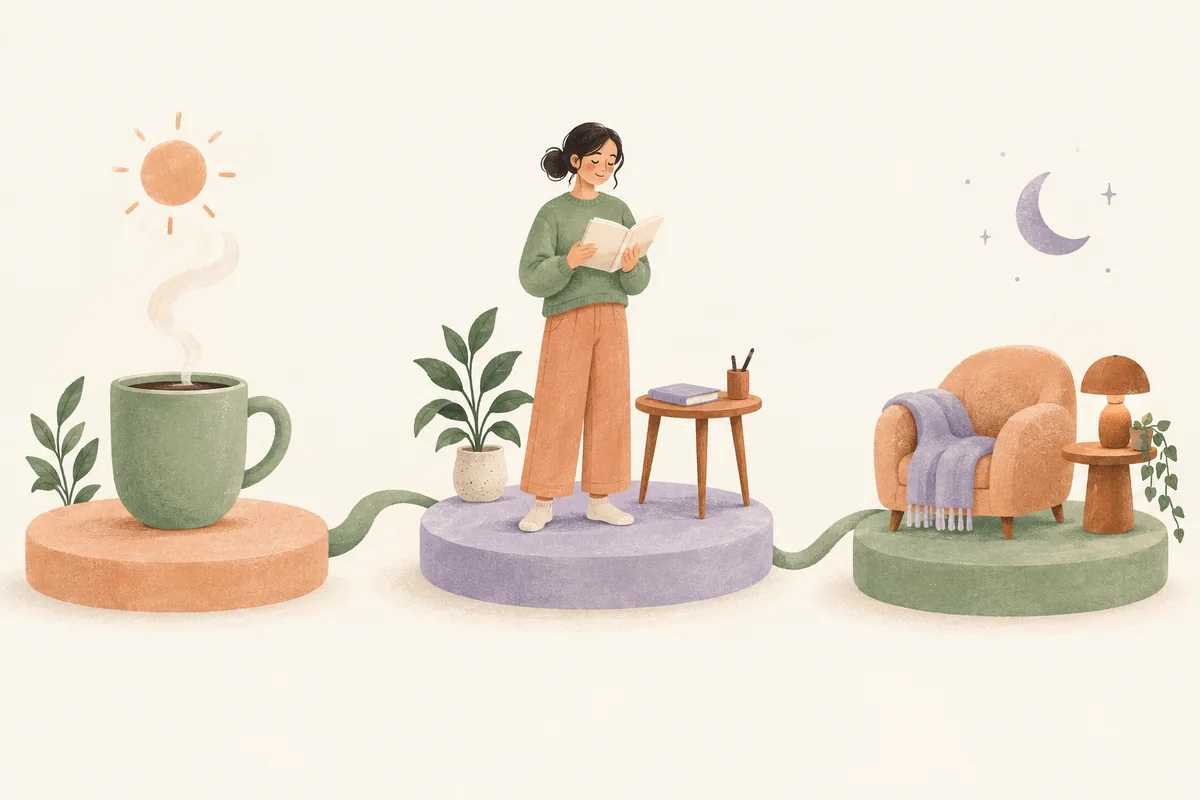
Habit stacking links something you want to do with something that already happens in your day. The existing action becomes your cue: when it finishes, you begin the new action. James Clear describes this approach as habit stacking and credits BJ Fogg's anchoring method in Tiny Habits.
The usual formula is “After I [current habit], I will [new habit].” For example, “read more” leaves the starting moment open. “After I put my breakfast plate away, I will read one page at the table” names the moment, the place, and a small action you can finish.
Psychologists call this kind of plan an implementation intention: an if-then plan that names when and where you will act. A 2006 meta-analysis by Gollwitzer and Sheeran of 94 independent tests found that such plans had a medium-to-large positive effect on reaching goals. Those studies tested if-then planning in general, not these particular examples or habit stacking under that name.
Choose one example that suits your life. The times below estimate the added action, not the activity that comes before it. Morning can mean after waking for a night shift, and work can mean study or another regular commitment. You can adapt the objects and setting without changing the basic pairing.
Morning habit stacking examples
Look for a moment with a little room around it. Keep any book, notebook, or other material where you will use it. These ideas can also fit into your existing morning routine.
1. Breakfast plate → one page of reading
Pairing: After I put my breakfast plate away, I will read one page of the book beside my seat. Leave a bookmark where you stopped so there is no searching first.
Time: about 1–2 minutes. If the cue is missing: after sitting down with your first drink, read the page there. Use a book you can bring along if you eat away from home.
2. First handwash → fill a glass of water
Pairing: After I dry my hands following my first morning handwash, I will fill a glass of water and put it where I will have breakfast. The action is simply making the drink available.
Time: about 30 seconds. If the cue passes unnoticed: fill the glass when you set out your breakfast cup or plate.
3. Calendar check → name one thing to look forward to
Pairing: After I close my morning calendar check, I will write one thing I am looking forward to today. It can be a call, a meal, or ten quiet minutes with a book.
Time: about 1 minute. If you do not check a calendar that day: write the line after sitting down for your first meal.
4. Getting dressed → put one item away
Pairing: After I finish getting dressed, I will return one out-of-place item to its home. Choose something nearby, such as yesterday's sweater on a chair, and stop after that item.
Time: about 30 seconds. If the morning is interrupted: use the moment you next enter the bedroom after breakfast.
5. Breakfast drink → review three vocabulary cards
Pairing: After I place my breakfast drink on the table, I will review three vocabulary cards. Keep the cards ready instead of spending the session choosing a lesson.
Time: about 2 minutes. If you skip the drink: use sitting down for your first break. This can be a workday pairing if weekends have a different rhythm.
6. Unplugging the phone → check the first appointment
Pairing: After I unplug my phone in the morning, I will check the time and location of my first appointment. Finish once you know what you need for it.
Time: about 30 seconds. If the phone was not charging: check after picking it up from its usual overnight place.
7. Picking up keys → check one essential item
Pairing: After I pick up my keys to leave, I will check that my chosen essential is in my bag or pocket. Pick the thing you repeatedly forget, such as a pass or glasses case.
Time: about 20 seconds. If you leave without keys: use lifting your bag instead. On days you stay home, this departure habit is not due.
8. Opening the curtains → pause at the window
Pairing: After I open the curtains, I will spend one minute looking outside before starting the next task. Notice the weather or something happening in the street.
Time: 1 minute. If the curtains are already open: use your first visit to the window. This can be a quiet pause even when your day starts after dark.
Workday habit stacking examples
Choose cues from your actual work: opening a notebook, finishing a scheduled message check, or putting lunch away. Use a workday schedule for these examples. For broader planning, see our guide to productivity habits at work.
9. Putting down your work bag → write one priority
Pairing: After I put my work bag down, I will write the one task I want to make progress on first. Use an action such as “draft the opening paragraph” instead of a broad project name.
Time: about 1 minute. If you work without a commute: use opening your work notebook or planner for the first time.
10. Opening the main document → remove one distraction
Pairing: After I open the document I am about to work on, I will close one unrelated tab or app. Then return to the document.
Time: about 20 seconds. If your work is on paper: after opening the notebook, move one unrelated item out of the working area.
11. Finishing an inbox check → five minutes on a chosen task
Pairing: After I close my first planned inbox check, I will work on my chosen task for five minutes. Have the task named before opening the inbox so you can return to it.
Time: 5 minutes. If you do not check messages that morning: begin after reading your task list. Choose a moment when your role allows an uninterrupted block.
12. Ending a meeting → capture the next action
Pairing: After I leave a meeting, I will write down the next action I own and any agreed deadline. If I have no action, I will note that instead of inventing one.
Time: about 1 minute. If the meeting becomes an asynchronous update: use finishing the relevant message or project note. No meeting or update means no entry is needed.
13. Saving before a break → leave a restart note
Pairing: After I save my work before a break, I will write a short note naming the next step. “Check the figures in paragraph three” gives me somewhere specific to resume.
Time: about 30 seconds. If you work in an autosaving tool: use closing the working tab; on paper, use putting the pen down for the break.
14. Putting lunch away → take a movement break
Pairing: After I put my lunch container or plate away, I will take two minutes for a short walk or another comfortable movement break.
Time: 2 minutes. If lunch happens on the go: use finishing your first seated break later in the shift. Choose movement and surroundings that work for you.
15. Finishing with a downloaded file → put it in its folder
Pairing: After I finish using a file I downloaded for work, I will save it in the relevant project folder with a recognizable name. Follow your workplace's file-handling rules.
Time: about 1 minute. If an interruption breaks the sequence: handle that file when closing the project at the end of the session. This habit is only due when there is a file to organize.
16. Returning from a break → clear one piece of clutter
Pairing: After I return to my workspace from my afternoon break, I will put away one item that is no longer needed. That might be an empty cup or a finished reference sheet.
Time: about 30 seconds. If the break does not happen: use finishing your final task of the shift. Keep the action to one item.
17. Finishing the day's status note → choose tomorrow's first task
Pairing: After I finish my end-of-day status note, I will write the first useful action for my next workday. Leave it somewhere I will see when I start.
Time: about 1 minute. If your role has no status note: use closing your planner or preparing to shut down your main work tool.
Evening habit stacking examples
Use the end of a meal, an activity, or the workday to make space for one small action. For a complete wind-down plan, use the evening routine guide.
18. Putting away your keys → give the phone a home
Pairing: After I put my keys in their usual place, I will put my phone in a chosen spot for the next ten minutes. Choose somewhere that still lets you hear necessary calls.
Time: about 20 seconds to put it away; a 10-minute window. If you have been home all day: use putting away your work materials.
19. Finishing dinner cleanup → prepare one breakfast item
Pairing: After I finish clearing dinner, I will set out one thing for breakfast, such as a bowl and spoon or a tea mug.
Time: about 1 minute. If you eat out: use arriving back in the kitchen. Set out only items that can safely stay there overnight.
20. Turning off the TV → read two pages
Pairing: After I turn off the TV for the evening, I will read two pages from the book left beside my seat. A short session can be the whole plan.
Time: about 2–4 minutes. If you do not watch TV: use changing into your sleepwear. The reading habit guide offers more ways to fit a book into your day.
21. Clearing your evening plate → send a thoughtful message
Pairing: After I put away my plate from the evening meal, I will send one short message to someone I want to stay in touch with. Share something specific that made you think of them.
Time: about 1 minute. If there is no plate to clear: use putting your meal packaging away. A reply does not have to happen that evening.
22. Changing out of work clothes → practice a small skill
Pairing: After I change out of my work clothes, I will spend two minutes practicing a skill with the materials already ready. Play one familiar phrase on an instrument or draw one nearby object.
Time: 2 minutes. If you wear the same clothes all day: use closing your work bag or putting your work notebook away.
23. Washing the last cup → write one reflection
Pairing: After I wash my last cup of the evening, I will write one sentence about something I want to remember from today. Keep the notebook and pen in their own dry spot nearby.
Time: about 1 minute. If someone else washes up: use switching off the kitchen light. For more prompts, see the Stoic evening review.
24. Finishing a shared meal → check tomorrow's plans
Pairing: After we finish our evening meal together, we will take two minutes to mention any plans the other person needs to know about tomorrow.
Time: 2 minutes. If your schedules do not overlap: send a short note after your own meal and read the reply when you can. Our habits for couples article has more shared options.
25. Putting away the toothbrush → record today's habit
Pairing: After I put away my toothbrush at night, I will record whether I did the one habit I am practicing. Use a notebook or a tracker, and record the action as it actually happened.
Time: about 30 seconds. If you miss that moment: use setting your alarm. Leave the entry incomplete when you did not do the habit.
Choose a cue that fits the action
Before choosing a pairing, walk through it in the real place. A book left upstairs will not help much if your breakfast ends with a rush out of the front door. Check three things:
- You can recognize the exact moment. Putting a plate in the sink is easier to identify than “sometime in the morning.”
- The action is possible there. You have the materials, a little time, and permission to pause.
- The cue happens on the right days. A commute can anchor a workday habit; it needs a different plan if the goal also applies at weekends.
Choose a backup only for the circumstances that need it. If you already did the action after the usual cue, you do not need to repeat it after the backup. For occasional actions, such as organizing a downloaded file, judge the opportunities that occurred rather than expecting a daily entry.
A fill-in habit stacking template
Copy this into a notebook or notes app, or download the plain-text template. Complete one plan before adding another.
My pairing: After I ____________________, I will ____________________.
Place and materials: I will do it at ____________________, with ____________________ ready.
When it is due: ____________________.
Time for the added action: ____________________.
My minimum that counts: ____________________.
If the usual cue is missing: After ____________________, I will ____________________.
My record: I will log ____________________ in ____________________.
My review date: ____________________.
Completed example: After I put my breakfast plate away on weekdays, I will read one page at the kitchen table. I will keep my book there with a bookmark. I will allow about two minutes, and one page counts as done. If I skip breakfast, I will read after sitting down with my first drink. I will check off “Read one page” in my tracker and review the timing on Sunday.
If you want a ten-minute reading target instead, record the minutes you actually read. A one-page session is useful progress, but it does not automatically meet a ten-minute target.
What to change when the cue fails
| What happened | What to try next |
|---|---|
| The cue never happened. | Use the backup you chose, or mark the habit as not due if the plan only applies to that event. |
| The cue happened, but you forgot. | Put the material or a written prompt where the cue happens. |
| You remembered but had no time. | Choose a smaller useful action or move it to a less rushed moment. |
| Weekdays worked; weekends did not. | Keep the weekday cue and choose a separate weekend one if the habit is due then. |
| Several actions piled up after one cue. | Keep one pairing while you learn whether that moment has enough room. |
For example, imagine you read after breakfast on Monday and Tuesday, then left early without breakfast on Wednesday. You used the first-drink backup on Wednesday but forgot it on Thursday. At the review, you could move the book beside your cup or decide that lunchtime is the more reliable cue on early-start days. That is a practical adjustment to test, rather than a reason to rebuild the whole routine.
If the same obstacle keeps returning, the habit troubleshooting guide goes into more detail.
Track the action and review the week
You can record the new action on paper or in an app. You do not need to log every existing cue as another habit. For the reading example, one entry named “Read one page after breakfast” is enough to remind you of the pairing.
In Productify, choose the schedule, set a check-off or measurable target, and log what you do. The free plan supports up to 5 personal habits. If you add a reminder, place it near a time when you can act; the notification does not know when your breakfast ends.
After a week, ask whether you noticed the cue and whether the action fitted that moment. Keep it, shrink it, or change the cue based on what happened. One week is a useful review point, not a deadline for a habit to become automatic. Our habit-formation timeline article explains that distinction.
The pairings, timing estimates, fallbacks, and template here are Productify editorial suggestions. The method attribution above links to the original explanation; these particular examples have not been tested as a program. For a step-by-step first attempt, follow the daily habit starter guide.
Frequently asked questions
The usual formula is “After I [current habit], I will [new habit].” For example: “After I put my breakfast plate away, I will read one page.” Name a specific moment, a small action you can finish there, and a backup for days when the first action does not happen.
After putting your breakfast plate away, read one page of a book kept nearby. The existing action gives you a specific starting cue, and one page gives the new action a clear finish. If you skip breakfast, choose another reliable cue, such as sitting down with your first drink.
Begin with one existing cue and one new action so you can see whether the pairing fits. Add another action only when the first is manageable. There is no universal ideal number, and a long chain is unnecessary for using the method.
In these examples, the existing action finishes and then the new one begins. For instance, finish your meal, put the plate away, then read a page. You do not need to divide your attention between two activities.
Yes. Look for events that still happen even when the time changes, such as getting dressed, finishing a meal, or ending a shift. Choose different cues for different kinds of days when needed. A workday cue does not have to be your weekend cue.
Make the connection easier to notice: leave the book beside the breakfast place, put the notebook on your desk, or write the pairing where you will see it. Also check whether there is actually time to act. If the same cue keeps failing, try a better moment.
Track the new action as a habit, choose its schedule and target, and record what you complete. You can include the cue in the habit name, such as “Read one page after breakfast.” A time-based reminder can support the plan, but it does not detect whether you finished breakfast. Productify is free for up to 5 personal habits.