How to Make Journaling a Habit: Start With One Line a Day
Most journals don’t stop because people run out of things to say. They stop because the habit was set up like an essay assignment. Set it up like any other habit instead.
A new journal usually starts well. The first few entries run a page or more, then a busy night comes, then two, and by the third week the notebook or app hasn’t been opened in days. The fix isn’t more motivation. It’s the same thing that works for any other habit: a minimum small enough for your worst day, a fixed moment to do it, and a record you actually look at.
Why most journals stop after a few weeks
When a journaling habit fades, it is usually for one of four reasons:
- The minimum is too big. If an entry means a full page, a tired evening means no entry.
- There is no fixed moment. “Sometime tonight” competes with everything else, and it usually loses.
- Every entry starts from a blank page. Deciding what to write about takes more effort than writing it.
- A missed day feels like failure. After a gap, the journal starts to feel like evidence against you, so it stays closed.
Each section below deals with one of these.
Start with one line a day
Decide now that one sentence counts as a full entry. James Clear suggests exactly this in his one-sentence journaling method: a single line per day, so the habit survives the days when you have nothing left. Write more whenever you feel like it, but never require it.
One line is enough to bring a day back when you read it later:
- Walked after lunch instead of scrolling. Felt better all afternoon.
- Skipped stretching again. Too late by the time I remembered.
- Long day. Glad I cooked instead of ordering.
The short minimum also keeps the habit honest on bad days. You don’t have to make a hard day sound good, or write it out in full. You only have to put one true sentence on the page. For more on picking a minimum that still means something, see how to start a daily habit.
Attach it to something you already do
Choose a moment that already happens every evening, and write the plan as an if-then sentence: “After I brush my teeth, I write one line in my journal.” In a meta-analysis of 94 studies, Peter Gollwitzer and Paschal Sheeran found that deciding in advance when and where you will act had a medium-to-large effect on reaching goals.
Good cues for journaling are the ones that never get skipped:
- right after your last habit of the day, while your habit tracker is still open;
- after brushing your teeth;
- when you put your phone on the charger for the night;
- after the kids are in bed, or after the last dog walk.
Then put the journal where the cue happens. A notebook on your pillow or next to the toothbrush gets written in; one on a shelf in another room doesn’t. On a phone, that means a reminder at the time you usually do the cue, or an app that puts the journal in front of you at that moment. If you also have a wind-down routine, make the journal its last step.
Answer a question instead of facing a blank page
A question decides what to write about, so all that’s left is answering it. Pick one for the first week and keep it. Asking the same question every day also makes your entries easy to compare later.
About the day
- What made today easier?
- One small win from today.
- What took more energy than it should have?
About your habits
- Which habit was hardest today, and why?
- What got in the way of the one I skipped?
- What would make tomorrow’s habit easier to start?
About tomorrow
- What is the first thing I’ll do tomorrow?
- What will I do differently tomorrow?
“One small win” earns its place. Teresa Amabile and Steven Kramer collected nearly 12,000 daily diary entries from 238 employees and found that people’s best workdays were the ones where they made progress, often in small steps. Writing down the small win is a way of noticing progress that would otherwise go unrecorded. That study was about work, but the habit of noticing transfers.
The three questions of the Stoic evening review also work well as a set: what went well, where did I fall short, and what will I do differently tomorrow? For a longer list, with an example answer for each question and when to use it, see these 8 end-of-day reflection questions.
Write next to your habit record
A checkmark records that you did something. A line in your journal records why it was easy or hard. Kept side by side, they explain each other. After a few weeks you might notice that the evening walk disappears every Tuesday, and your notes say “late meeting” each time. The fix is then obvious: move Tuesday’s walk to lunchtime.
Looking at your progress is part of what makes it work. Across 138 studies, a 2016 meta-analysis by Harkin and colleagues found that prompting people to monitor their progress improved goal attainment on average. A journal adds the context a tick can’t hold.
Count the journal itself as a habit. Add “Write one line” to your habit tracker, check it off after you write, and you get a streak and a history for your journaling as well.
Paper, phone or both
Use whichever one will be within reach at your cue. Paper has no notifications and nothing else to open, and many people find writing by hand slower in a good way. A phone is always with you, can remind you, and can sit next to your habit record. Some journal apps, Productify’s diary included, let you write or draw by hand on the screen as well as type.
The only setup that reliably fails is two journals. Pick one place for your daily line. If you also love a paper notebook for longer writing, keep it for the days you want more, not as a second daily obligation.
What to write on bad days and busy nights
On a hard day, one plain sentence is enough: “Bad day. Argument at work, couldn’t switch off.” You don’t need to analyze it, and you don’t need to end on a positive note. The entry is there so the day is recorded, not resolved.
Keep your expectations realistic. Writing about feelings has been studied for decades: a 2006 meta-analysis of 146 randomized studies by Joanne Frattaroli found a small average benefit, with large differences between studies. A small preliminary trial of positive affect journaling, writing for 15 minutes three times a week for 12 weeks, found less mental distress than usual care in adults with medical conditions and elevated anxiety. Journaling can help, but it isn’t a treatment. If low mood or worry lasts for weeks, talk to a doctor or someone you trust.
If a busy mind keeps you awake, end the entry by looking forward. In a 2018 sleep-lab study, 57 young adults spent five minutes before bed writing either a to-do list for the coming days or a list of tasks they had already done. The to-do group fell asleep about nine minutes faster on average, and the more specific their list, the faster they fell asleep. It was one small study, but adding “First thing tomorrow: …” to your line costs nothing.
If you miss a day, or a week
Don’t go back and fill in the days you missed. Write today’s line and leave the gap. A gap is information; a week of entries written from memory on Sunday is not.
Try not to miss two days in a row. One missed day is a pause; two in a row is how a habit quietly stops. That is why a good habit tracker keeps your history when a streak breaks: the 20 days you did write still count.
After a longer break, restart with the smallest version: one line, the same cue, the same question. Then use your first entry back to answer one more question: what got in the way? If the cue disappeared (a new job, a trip, a new evening schedule), pick a new one before you start again.
Read it back once a week
Most of the value of a journal shows up when you read it. Once a week, take five minutes:
- Read the last seven entries in one go.
- Look at your habit record for the same week next to them.
- Notice what repeats: a time, a place, a person, a feeling.
- Choose one change for next week, and write it as the first line of your next entry.
Sunday evening works for most people, and it can replace that day’s entry. After a month, the weekly read-back is often the part of journaling people would miss most. It also feeds a weekly review if you already do one.
Keeping a habit diary in Productify
Productify is our app, so read this section with that in mind. Its diary gives you one paper page for every day, inside the habit tracker. Each page already shows the date, that day’s habits with their checkmarks, and a question to start you off, such as “What made today easier?” If the question doesn’t fit, tap ↻ for another one.
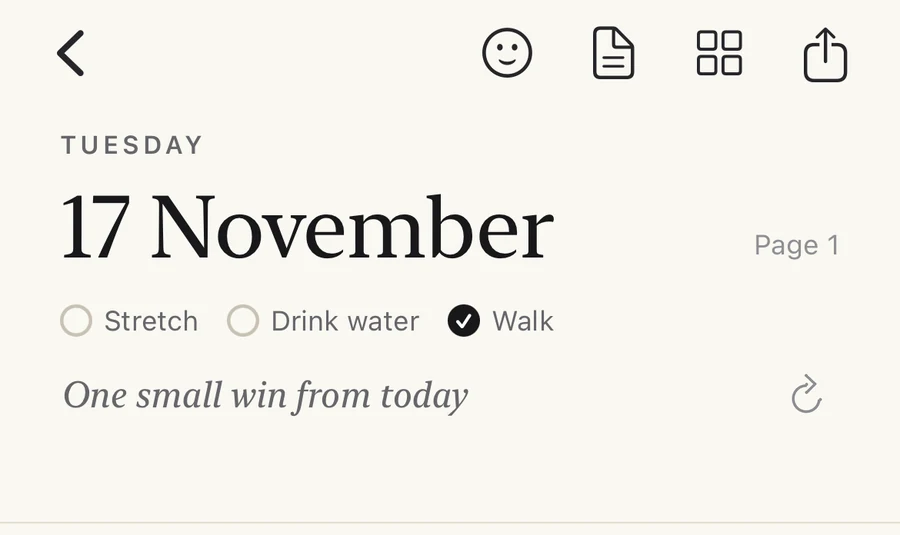
- The cue is built in. After 6 pm, once every habit due today is done or skipped, a “How was today?” card on the home screen opens the diary. You can also tap + and choose Diary.
- Type or write by hand. Type on the lines, or use the pencil, pen or highlighter to write or draw, with an eraser and undo.
- Stickers for days without words. 48 hand-drawn stickers for weather, mood, food, nature and habits.
- Easy to read back. Swipe across the date to go back a day, tap it for a calendar, or see all your pages in a grid.
- Private. Pages save by themselves and stay on your phone. You can export a page as an image if you want to share it.
The diary is part of the free plan, which covers up to 5 habits with no account required. If you’d rather keep everything on paper, a notebook next to one of the free printable habit trackers does the same job.
Sources and limits
- James Clear on one-sentence journaling: writing a single line per day.
- Gollwitzer & Sheeran (2006), Implementation intentions and goal achievement: a meta-analysis of effects and processes. Advances in Experimental Social Psychology, 38, 69–119.
- Amabile & Kramer, The Progress Principle (Harvard Business School Working Knowledge): nearly 12,000 daily diary entries from 238 employees in seven companies.
- Harkin et al. (2016), Does monitoring goal progress promote goal attainment? A meta-analysis of the experimental evidence. Psychological Bulletin, 142(2), 198–229.
- Frattaroli (2006), Experimental disclosure and its moderators: a meta-analysis. Psychological Bulletin, 132(6), 823–865.
- Smyth et al. (2018), Online positive affect journaling in general medical patients with elevated anxiety symptoms: a preliminary randomized controlled trial. JMIR Mental Health, 5(4), e11290. 70 participants; the authors call for larger studies.
- Scullin et al. (2018), The effects of bedtime writing on difficulty falling asleep: a polysomnographic study comparing to-do lists and completed activity lists. Journal of Experimental Psychology: General, 147(1), 139–146. 57 participants, one night in a sleep lab.
- For the 18 to 254 day range in the FAQ: Lally et al. (2010), covered in how long it takes to build a habit.
The studies above measured groups of people under specific conditions. They suggest what is likely to help, not what will work for you; the weekly read-back is how you find that out.
Frequently asked questions
One line is enough to build the habit. Decide that a single sentence counts as done, and treat anything longer as a bonus. Most people write more on some days once the habit is in place, but the short minimum is what keeps it going on busy days.
Either works. Pick the time with the most reliable cue in your day. Evening suits looking back at what happened and how your habits went; morning suits planning. If worries about tomorrow keep you awake, end an evening entry with tomorrow’s first step.
Answer one short question, such as “What made today easier?” or “One small win from today.” A question gives you somewhere to start, and repeating the same few questions makes your entries easy to compare when you read them back.
There is no fixed number. In a well-known study of new daily habits, the time it took for a behavior to feel automatic ranged from 18 to 254 days, with a median of 66. A short, daily entry at the same moment each day gives it the best chance.
Usually a diary means a dated record of each day, and a journal can be any kind of reflective writing. For building the habit the difference doesn’t matter: a page per day with one line on it works under either name.