Does Habit Tracking Work? What the Research Says, and Where It Backfires
A habit tracker is one of the simplest tools in behavior change: a record of whether you did the thing you planned. The research behind it is stronger than most self-help advice, and more nuanced than most habit apps admit.
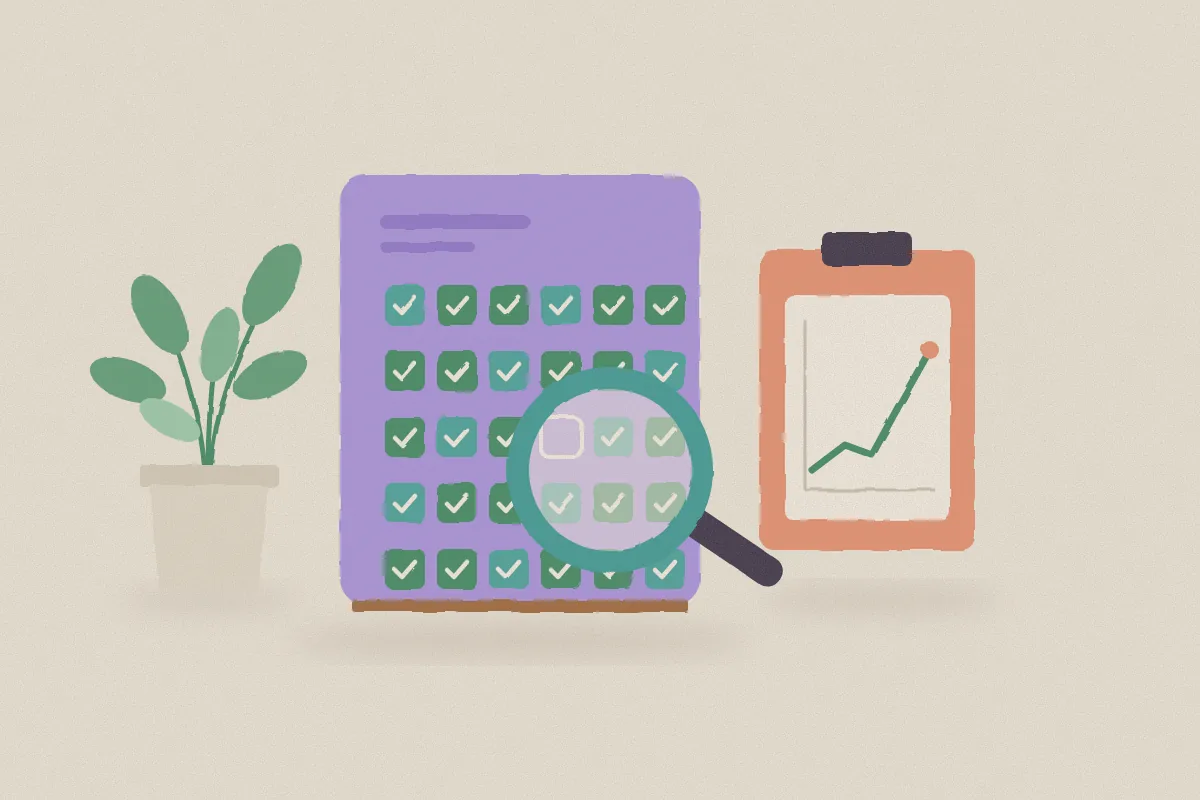
Most people who try a habit tracker know both sides of it. For two weeks the grid fills up and it feels like the thing that finally works. Then a busy Thursday leaves a gap, the gap becomes three, and the tracker goes in a drawer.
So does tracking your habits help, or does it just make you feel productive for a while? This article looks at what the studies found, including the parts that are less flattering for habit apps, ours included.
What is a habit tracker?
A habit tracker is a record of whether you did a repeated action on the days you planned it. It can be a grid on paper, a calendar you cross off, or an app that keeps your streak and history. Unlike a to-do list, nothing disappears once it is done; the value is the pattern over weeks.
Researchers call this self-monitoring or progress monitoring: noticing and recording what you actually did, as opposed to what you meant to do. It is one of the most widely studied techniques in behavior change, which is why there is real evidence to look at.
What the research says
The strongest evidence comes from a 2016 meta-analysis in Psychological Bulletin by Benjamin Harkin and colleagues. They pooled 138 experiments with 19,951 participants in which people were randomly assigned either to an intervention that prompted them to monitor their progress or to a comparison group.
- Monitoring went up a lot. The interventions made people check their progress much more often (an average effect size of d = 1.98).
- Goal attainment went up too. People in the monitoring groups reached their goals more often (d = 0.40). That is a small-to-moderate effect: useful and reliable, not magic.
- More monitoring, more progress. The increase in how often people monitored explained the improvement in results, which points to the monitoring itself doing the work.
- Writing it down and sharing it helped more. The effect was larger when progress was physically recorded and when it was reported to someone else or made public.
Two caveats keep this honest. Many of the experiments were about health behaviors such as eating, exercise and weight, so the results fit those best. And reviews of more specific areas are more cautious: a systematic review of self-monitoring in weight loss found a consistent link between monitoring and results across 22 studies, but rated the evidence as weak because most studies relied on self-report and had narrow samples.
In short: keeping a record of a behavior reliably helps people do it more often. It is not a guarantee, and it works best as part of a plan rather than on its own.
Why tracking helps
Harkin and colleagues describe monitoring as the step that sits between setting a goal and reaching it. In everyday terms, a tracker does a few useful things:
- It turns an intention into a daily question. "Exercise more" becomes "did I walk after lunch today?", which you can answer with a yes or a no.
- It shows drift early. A grid makes it obvious when weekends or late meetings keep knocking a habit out, while there is still time to adjust the plan.
- It gives quick feedback. You see the result of today, not just the distant goal, which is easier to act on.
- It keeps the habit in view. A record you look at daily is a reminder that the plan exists at all.
Tracking is not the same as a habit
This is the part most habit apps skip. Doing something often and doing it automatically are different things, and tracking mainly helps with the first.
In a four-week study of habit formation, Katarzyna Stawarz and colleagues found that relying on reminders helped people repeat a behavior but got in the way of it becoming automatic, while tying the behavior to an event in the day (such as "after I make coffee") increased automaticity. Simple rewards did not help. When the same team reviewed 115 habit apps, most were built around tracking and reminders rather than cues tied to an existing routine.
The best-known study on habit formation points the same way. Phillippa Lally and colleagues asked volunteers to repeat an eating, drinking or exercise behavior daily in the same context. The estimated time to reach near-automaticity ranged from 18 to 254 days, with a median of 66, depending on the person and the behavior, and missing a single opportunity did not materially affect the process. You can read more in how long it takes to build a habit.
The takeaway: let a cue in your day trigger the habit, and let the tracker be the record. If the only thing that makes you act is a notification, you may be building a habit of responding to notifications.
When habit tracking backfires
Two well-designed lines of research show where tracking can work against you.
It can take the fun out of things you enjoy
In six experiments, marketing professor Jordan Etkin had people walk, read or color, with or without measuring how much they did. Measuring made people do more, but it made the activities less enjoyable, and in some studies it reduced how much people wanted to continue afterwards. When the activity was framed around learning rather than fun, measuring it no longer reduced enjoyment.
What to do: be careful about counting things you already do for pleasure. Track that you read, not how many pages, or leave enjoyable activities off the tracker entirely.
A broken streak can make you quit
In seven studies, Jackie Silverman and Alixandra Barasch found that people kept up a behavior more when their log showed an intact streak than when it showed a broken one, even when their actual past behavior was the same. People came to treat the streak itself as a goal. The drop was larger when people blamed themselves for the break, and smaller when the streak could be repaired.
What to do: don't let a single number carry all the meaning. Look at totals and consistency alongside the streak (24 out of 30 days is a good month), and decide what a missed day means before it happens. Our streak and consistency calculator shows both.
How to make habit tracking work
Put together, the research suggests a short set of rules:
- Track the action you control. In Harkin's review, monitoring had its biggest effect on whatever was being monitored: tracking a behavior changed the behavior, tracking an outcome changed the outcome. For a habit, track the action itself. "Walk 20 minutes" beats "get fit".
- Write it down. Recorded progress beat progress kept in your head. A tick on paper or in an app counts.
- Tie the habit to a cue, and check in at a fixed moment. "After lunch, walk; after dinner, log it" gives you both the trigger and the record.
- Decide what a missed day means in advance. One miss does not undo a habit. The rule "never miss twice" is easier to keep than "never miss".
- Review once a week and change one thing. Look at which planned days were missed and why, then adjust the time, the cue or the size of the habit.
- Consider telling one person. Reported progress had a larger effect than private progress. An accountability partner or a shared habit can supply that.
- Keep the list short. Start with one to three habits you actually want, and add more once checking in is easy. If you need ideas, start with what habits to track.
How to keep track of habits: paper, phone or app
The studies favor recording over remembering; they do not crown a format. Pick the one you will look at every day.
- Paper. A printed grid on the fridge or desk is hard to ignore and pleasant to fill in. Try the free 2027 habit tracker printable or a 30-day habit tracker for a single habit.
- What is already on your phone. Reminders, Health and Journal on iPhone can cover simple cases. See how to track habits on iPhone for what each one does and where it stops.
- A habit tracker app. Useful when you want reminders per habit, weekly targets for habits that are not daily, and a history you don't have to keep yourself. In Productify, each habit gets its own reminder, you see your streak next to your personal best and your history, and weekly targets cover habits that are not daily. It is free for up to 5 habits, with no account.
Whatever you choose, the setup in how to use a habit tracker applies: one specific action, a schedule, a clear finish line and a weekly look back.
Sources
- Harkin, Webb, Chang, Prestwich, Conner, Kellar, Benn and Sheeran (2016), Does monitoring goal progress promote goal attainment? A meta-analysis of the experimental evidence. Psychological Bulletin, 142(2), 198–229.
- Burke, Wang and Sevick (2011), Self-monitoring in weight loss: a systematic review of the literature. Journal of the American Dietetic Association, 111(1), 92–102.
- Stawarz, Cox and Blandford (2015), Beyond self-tracking and reminders: designing smartphone apps that support habit formation. Proceedings of CHI 2015, 2653–2662.
- Lally, van Jaarsveld, Potts and Wardle (2010), How are habits formed: modelling habit formation in the real world. European Journal of Social Psychology, 40(6), 998–1009.
- Etkin (2016), The hidden cost of personal quantification. Journal of Consumer Research, 42(6), 967–984 (author manuscript).
- Silverman and Barasch (2023), On or off track: how (broken) streaks affect consumer decisions. Journal of Consumer Research, 49(6), 1095–1117.
We make Productify, a habit tracker app. The summaries above describe what each study measured; the practical rules are our reading of them, not tested outcomes.
Frequently asked questions
For doing a behavior more often, yes. A review of 138 randomized experiments found that prompting people to monitor their progress improved goal attainment, with a small-to-moderate average effect. The effect was larger when progress was written down or shared. Tracking alone does not make a behavior automatic; a consistent cue and repetition do that.
A habit tracker is a record of whether you did a repeated action on the days you planned it. It can be a grid on paper, a calendar you mark, or an app that keeps your streak and history. Unlike a to-do list, nothing disappears when it is done: the value is the pattern over weeks.
The research favors recording progress over keeping it in your head; it does not show that paper beats an app or the other way round. Choose the one you will actually check every day. Paper suits a few habits and a wall or desk you pass daily; an app suits reminders, weekly targets and a history you do not have to keep yourself.
You can. If you do a habit without thinking and tracking adds nothing, take it off the list and make room for the next one. Keep tracking anything that still slips on busy weeks, and anything where the record itself is useful, such as how often you trained this month.
Start again at the next planned opportunity. In the best-known habit formation study, missing one opportunity did not materially affect the process. What matters more is not letting one miss turn into a week, so decide in advance that a missed day means picking it back up, not starting over.